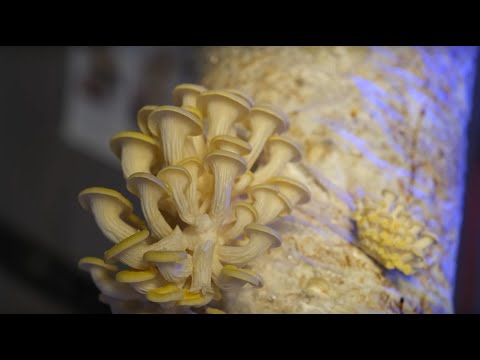
Mushroom growing turns agricultural waste into a food crop in about a month, on a floor area smaller than a bedroom, without owning land and without waiting for rain. This module covers why that business works, who actually buys mushrooms in African cities, the three different businesses hiding inside the words "mushroom farming", the one number that measures whether you are any good at it, and how to cost a cycle with your own local prices. It also tells you plainly where the evidence runs out, because the price and market data for African mushrooms is thin and this course will not invent it.
What you will be able to do after this module
Explain why mushroom growing needs no land ownership and no growing season
Name the three buyer categories and what each one demands
Distinguish the fresh, dried and spawn business models by risk and skill required
Calculate biological efficiency correctly using dry substrate weight
List the six cost categories every mushroom enterprise budget must itemise
Build a batch record that supports contamination tracing and BE calculation
Explain why mushroom growing needs no land ownership and no growing season
Describe the cash-conversion cycle of a mushroom crop against a field crop
Identify the waste streams in your own area that a mushroom crop can eat
Almost every farming business asks you the same two questions first. How much land do you have? And when does the rain come? Mushroom growing asks neither.
A mushroom crop grows inside a bag, on a shelf, in a room. The Botswana production guide describes a minimum-viable growing house as one room of roughly 6 m by 5 m by 3 m high, used first for spawn running and then for fruiting. That is 30 square metres of floor. You can rent it, borrow it, or build it out of gum poles and a locally cheap wall material. Nobody has to give you a title deed to start.
The crop does not need rain either, because you supply the water yourself when you wet the substrate. It does not need sunlight to feed itself, because a fungus does not photosynthesise. It needs shade, moisture, air and warmth, and those are things you can manage in a shed.
Now the part that changes the business. A first flush of oyster mushroom can be harvested roughly a month after you spawn a bag under simple tropical conditions. Look at what the African trials actually measured, counting from the day the bag was spawned. In the Ethiopian trial at Wondo Genet, cotton seed hull gave a first harvest at 27 days, paper waste at 39 days, wheat straw at 40.67 days and sawdust at 37 days. In the Nigerian trial at Akure, pinheads appeared 18 to 25 days from spawning. In the Kenyan trial, maize cobs pinned at 19 days, sawdust at 22 and coconut fibre at 23, against a 28-day control.
Compare that with a maize crop or a goat. You put money in and you take money out in the same month. That short cash-conversion cycle is the whole commercial argument for teaching mushrooms as a standalone business rather than as a corner of a horticulture course. It means a small amount of working capital turns over many times a year instead of once.
And what does the crop eat? Waste. Straw, sawdust, maize cobs, cotton waste, banana fibre, bean straw, rice straw. These are materials that in most African farming systems are burned, dumped, or left to rot slowly because almost nothing else can digest them. Mushrooms are white-rot fungi. They secrete enzymes that break down lignin, the tough polymer that makes wood and straw rigid and that most bacteria and animals cannot digest at all. That single biological ability is what makes the business possible: you buy something worthless and sell something valuable, and the fungus does the conversion.
Think of yourself accurately. You are not a vegetable grower. You are someone who turns local agricultural waste into food and income. That description is the actual biological transaction, and it also tells you where to look for your cheapest input: a sawmill, a maize sheller, a bean thresher, a cotton gin, a banana plantation.
Be honest about the limits too. This document that the course is built on has good African agronomic evidence for oyster mushroom - real substrate trials from Ethiopia, Nigeria and Kenya - but far thinner evidence on whole-farm economics, on growing-house engineering for African conditions, and on market prices. No African building-physics study of an actual constructed low-cost mushroom house, measuring indoor against outdoor temperature and humidity across a full production cycle, was available. So the 6 m by 5 m room above is a starting brief from one national guide, not a proven optimal design. Treat it as a place to begin and then measure your own room.
One more structural advantage worth naming. Because the crop lives on a shelf rather than in a field, you can stack it. Floor area is not the limit on your production; shelving is. A grower with 30 square metres of floor and three levels of shelving has three times the growing surface of a grower with the same room and no shelves, for the price of some gum poles or timber, which the Botswana guide names alongside aluminium as suitable shelving material.
Minimum-viable growing house
one room about 6 m x 5 m x 3 m high
Botswana production guide figure for a single room used for spawn running then fruiting; no African study measured an actual built low-cost mushroom house, so treat it as a starting brief, not an optimum
Days from spawning to first harvest
27 days on cotton seed hull, up to 40.67 days on wheat straw
Ethiopian trial at Wondo Genet, four substrates under identical conditions. Your own timing depends on substrate, spawn rate, temperature and strain
Days from spawning to first pins
19 days on maize cobs vs 28 days for the control
Kenyan trial. Maize cobs pinned faster than the reference substrate, which matters if you want the shortest possible cash cycle
Shelving materials named
gum poles, timber or aluminium
Botswana guide. Shelving, not floor area, is what limits how much you can grow in a given room
Do this today: walk or ride to the nearest sawmill, maize sheller or bean thresher and ask one question - what happens to the waste, and would they let you take some. Write down the answer, the name of the place, and the date.
Recommended viewing
These are free videos made by other people, not by rise AFRICA skills. Each one was checked against YouTube and is on topic. The written lessons are the course. Treat these as useful extra watching.
How to Easily Grow Oyster Mushrooms at Home
Von Malegowski
How to Grow Oyster Mushrooms on Straw: Introduction Part 1 of 5
cornellsmallfarms
SUPER LOW TECH OYSTER MUSHROOMS (and market garden update)
Richard Perkins
Lesson 1.2~12 min
Who Actually Buys Mushrooms
In this lesson
Name the three buyer categories and what each one demands
Explain the gap between mushroom availability and habitual consumption
Choose a marketing message based on what African consumers say matters most
The demand side is the weakest-evidenced part of this whole subject, and you deserve to be told that before you spend money. What follows is what is genuinely sourced, and where it stops.
Start with a finding that should change how you plan. A Nigeria and Kenya consumer study found that in a Nigerian survey, 65 percent of respondents had access to edible mushrooms, but only 38 percent consumed them regularly. Read that carefully. Nearly two thirds could get mushrooms. Barely more than a third actually ate them habitually. That gap is not a reason to give up. It is a description of your job. Part of your work as an early grower in a town that does not yet eat many mushrooms is education, recipes and taste familiarity, not simply putting a crate on a table and waiting.
The same review reports what African consumers say drives their buying. Taste is rated the most important purchase factor by roughly 50 percent of African consumers surveyed, a higher share than in the other world regions the source compared. Texture ranks lowest in importance to African consumers, at about 15 percent, relative to other regions. Note the caveat honestly: the review does not name the specific countries or sample sizes behind that regional split, so treat it as a directional signal rather than a precise population statistic.
But the direction is useful and it is actionable. Lead your selling with freshness and flavour, not with a health lecture. Let people taste. A cooked sample handed to a hotel chef or to a market shopper is doing exactly what the sourced evidence says matters most to your buyer.
Now, who are the buyers? Across the trade sources, three consistent categories appear, and they are worth using as a targeting checklist:
Hotels and restaurants. They want consistency and reliability more than they want the lowest price. They will ask you to deliver the same quantity on the same day every week. They may ask for an invoice or a licence.
Supermarkets and greengrocers. They want a packed, presentable, consistent product they can put on a shelf and mark up.
Direct household buyers, at farmers' markets or by delivery. Smallest volumes, best price per kilogram, and the segment where taste education pays off fastest.
Geography matters too. Kenyan trade reporting describes Nairobi as the country's highest-demand market, supplied substantially from Eldoret, Kisii and Kericho, with newer production hubs around Nairobi itself in Kiambu, Thika and Machakos. That is trade journalism rather than a peer-reviewed survey, and its tonnage and market-value figures could not be corroborated against an independent source, so treat any specific tonnage figure attributed to it as unverified. The structural point still stands and is worth acting on: demand concentrates in big cities, and growers cluster near those cities or on good transport routes into them.
Here is a concrete, dated example of a policy creating an opening. In Botswana, the fresh and frozen mushroom category was overwhelmingly imported - the source figure is 99.89 percent of national purchases sourced from South Africa - before a stated import-substitution policy took effect on 1 July 2024. That is one country, one policy, one date. Whether an equivalent policy exists in any other specific African country was not retrieved and you must check it locally. But the question is a good one to take to your own ministry of agriculture or trade: is anyone here trying to replace imported mushrooms with local production, and is there support attached to that?
Now the refusal. No peer-reviewed, dated, multi-country African price survey for fresh oyster or button mushroom was available. Specific shilling, naira, cedi or pula prices per kilogram circulating on farming blogs were checked and several were found to be internally inconsistent or unsourced. This course therefore gives you no target retail price anywhere, and you should be suspicious of any course that does. Your price is a number you go out and collect, from your own buyers, this month, and write down with the date next to it. Lesson 5 teaches you what to do with it once you have it.
Access versus habitual consumption
65 percent had access, 38 percent consumed regularly
Nigerian survey within a Nigeria and Kenya consumer study. The gap is a marketing and education task, not a reason to abandon the market
Taste as a purchase factor
about 50 percent of African consumers surveyed
Higher than the other world regions the source compared, with texture lowest at about 15 percent. The source does not name countries or sample sizes, so treat it as directional
Botswana imported share before policy change
99.89 percent sourced from South Africa
One country's stated figure before an import-substitution policy took effect on 1 July 2024. Whether a similar policy exists elsewhere was not retrieved and must be checked locally
African mushroom price per kilogram
not available - collect it locally
No dated, peer-reviewed, multi-country African price survey was available, and blog figures checked were internally inconsistent. Get your own prices from real buyers and record the date
Do this today: walk into one supermarket or greengrocer and one hotel or restaurant kitchen. Ask what they pay per kilogram for fresh mushrooms, how much they take a week, and whether their supply is local or imported. Write both answers down with today's date.
Recommended viewing
These are free videos made by other people, not by rise AFRICA skills. Each one was checked against YouTube and is on topic. The written lessons are the course. Treat these as useful extra watching.
Economics Of Mushroom Production | GroCycle
GroCycle
How to Grow Oyster Mushrooms on Straw: Introduction Part 1 of 5
cornellsmallfarms
Lesson 1.3~12 min
Three Businesses, Not One
In this lesson
Distinguish the fresh, dried and spawn business models by risk and skill required
Explain why spawn production should be a second-stage business, not a starting point
Decide which model to start with based on your own market and skill
"Mushroom farming" is not one business. It is at least three, and they need different skills, different equipment and different customers. You can run them separately or combine them as you grow, but you should choose deliberately rather than drift.
Model one is fresh mushroom production and sale. You grow, you harvest, you sell fresh, ideally the same day or well inside the shelf-life window. This is the core model this course is built around and it should be your first. It has the best-attested demand of the three, because the three buyer categories in Lesson 2 - hotels, greengrocers and households - are all buying fresh product. It also has the highest perishability risk. Fresh mushrooms are 85 to 95 percent water by weight, which is exactly why they are so perishable and why any bruising, packing pressure or delay in cooling shows up in visible quality within hours.
Model two is dried and value-added product. Drying converts a highly perishable fresh crop into a shelf-stable one. That is a structural change in your business, not just a processing step. A dried product can be transported further, held and sold out of season, and sold into a different customer segment altogether - a household or a hotel buying dried mushroom for stews and sauces is not the same customer as one buying fresh mushroom for a salad or a grill.
Be careful here, because this is where people quote numbers they cannot support. No African-specific price premium for dried versus fresh mushroom was retrieved. This course therefore gives you no premium figure and you must not build a plan on one you read on a blog. What you can rely on is the structural logic: shelf-stability opens markets that fresh mushroom physically cannot reach, and you can price that access when you find out locally what a dried-mushroom buyer will actually pay.
Model three is spawn production and sale to other growers. Spawn is mycelium pre-grown through a clean carrier, usually grain, that other growers buy to start their crops. It is a higher-skill, higher-margin business, and it serves growers rather than end consumers. It is a realistic growth path.
But it should be a second-stage business, and the reason is about consequences, not difficulty. If your own substrate batch fails, you lose one batch. If your spawn is bad, every customer who bought it loses their crop, all at once, and you lose your reputation with the entire local grower community in a single season. The cost of a spawn-quality failure is far higher than the cost of one grower's own bad batch. Spawn production also needs true sterile technique, not the pasteurisation that bulk substrate needs, because grain is such a rich medium that a single surviving mould spore overruns it.
So the sequence to teach yourself is: get model one working first, with working capital and a demonstrated production record, then add model two or three as an expansion path. This is the same caution the evidence gives about scaling generally - grow in deliberate, measured steps rather than jumping from a first successful trial batch to a large loan-funded expansion.
How do you actually choose between two and three when the time comes? Ask what your local gap is. If mushrooms in your town spoil on the way to market and buyers complain about condition on arrival, drying solves a problem you can already see. If growers around you are complaining that they cannot get reliable spawn, or that the spawn they bought arrived green or slimy, then spawn production is the gap - and you already know from your own bad batches how much that failure costs a grower.
One thing all three models share: they all rest on the same skills. Clean working, correct moisture, correct heat treatment, and honest records. There is no shortcut into model three that skips model one, because the sterile technique and the observation skill that make good spawn are built on cycles of your own crop where you learned what healthy mycelium looks like and what a contaminated bag smells like.
Water content of fresh mushrooms
85 to 95 percent by weight
This is why the fresh model carries the highest perishability risk, and why bruising, packing pressure and delayed cooling show up within hours
Number of business models
three - fresh, dried and value-added, spawn
They need different skills, equipment and customers. Sequence toward fresh first, with the other two as expansion paths once you have capital and a production record
Dried versus fresh price premium
not available - find out locally
No African-specific premium figure was retrieved. Teach yourself the structural logic - shelf-stability reaches markets fresh cannot - then price it with real local quotations
Substrate treatment versus spawn treatment
pasteurise bulk substrate, sterilise spawn grain
Grain is rich enough that a single surviving spore overruns it, which is why spawn production needs true sterile technique and is a second-stage business
Do this today: write down, in one line each, the three models and which one you will start with. Then write one sentence saying what would have to be true before you added a second model.
Recommended viewing
These are free videos made by other people, not by rise AFRICA skills. Each one was checked against YouTube and is on topic. The written lessons are the course. Treat these as useful extra watching.
Economics Of Mushroom Production | GroCycle
GroCycle
Growing Oyster Mushrooms Indoors - SPAWN & SAWDUST BLOCK PRODUCTION (2 of 5)
cornellsmallfarms
SUPER LOW TECH OYSTER MUSHROOMS (and market garden update)
Richard Perkins
Lesson 1.4~11 min
Biological Efficiency: The Number That Grades You
In this lesson
Calculate biological efficiency correctly using dry substrate weight
Compare sourced African BE figures across substrates and studies
Explain why a BE above 100 percent is not an error
There is one number that tells you whether your growing is getting better or worse, and most people in the trade calculate it wrong. Learn it properly now and it will guide every decision in this course.
Biological efficiency, written BE percent, is the fresh weight of mushrooms you harvested, expressed as a percentage of the dry weight of the substrate you grew them on. The Botswana guide states the formula:
BE percent = fresh mushroom weight divided by (dry substrate weight plus dry spawn weight), times 100.
Its worked example: a 3 kg bag yielding 1.8 kg of mushrooms gives BE = 60 percent. That is 1.8 divided by 3, which is 0.6, times 100.
Now the mistake that ruins the number. BE is computed against the dry weight of the substrate, not the wet, pasteurised, bagged weight. Substrate that has just been soaked to 65 to 70 percent moisture weighs far more wet than dry. If you divide your fresh mushroom yield by the wet weight, your BE will look artificially low, and you will conclude you are a worse grower than you are. Note honestly that this course could not fully verify whether the "3 kg" in that Botswana worked example refers to dry or wet weight - the arithmetic is only internally consistent if it means the dry-equivalent weight, which is what the definition line states. Take the definition as authoritative over the example.
That gives you the single most important record-keeping habit in the whole course: weigh and write down your dry substrate weight before you wet it. If you do not have that number, you cannot honestly calculate BE at the end, and no amount of care later will recover it.
Here are the sourced African BE figures, side by side, so you can see how much substrate choice matters:
Look at the spread within a single study. In Ethiopia, cotton seed hull gave more than seven times the BE of sawdust under identical conditions. That is not a small management difference. That is the same grower, the same room, the same spawn, and a different bag of waste material.
Now, why are some of those figures above 100 percent? Because BE compares fresh mushroom weight to dry substrate weight, and fresh mushrooms are 85 to 95 percent water. A substrate can and does produce a fresh mushroom weight greater than its own original dry weight, because most of that mushroom weight is water the fungus drew from the moisture in the bag. A BE over 100 percent is not an error and it is not a lie.
What should you aim at? The Botswana guide frames greater than 60 percent BE as a target for farmers to maintain, with superior operations exceeding 75 percent. Treat that as one national source's benchmark, not a universal pass mark - especially since the Kenyan bean straw results of 106 and 148 percent are well above that "superior" line.
One last thing worth understanding once. Because fresh mushroom is mostly water, the true dry-matter conversion is much lower than BE percent looks. Take the Botswana 60 percent BE example and the low end of the water range, 85 percent water. Only about 15 percent of the fresh weight is dry matter. So 60 percent times 15 percent is roughly 9 percent of the original dry substrate mass recovered as dry mushroom. That is a derived figure, not a published one. It is not a criticism of BE, which is the standard metric in every source here. It just means you should read a BE of 50 to 100 percent as a genuinely strong biological conversion, not compare it carelessly to a feed-conversion ratio quoted in different units.
BE formula
fresh mushroom weight divided by dry substrate weight plus dry spawn weight, times 100
Botswana guide definition. Always against dry substrate weight, never the wet bagged weight, or your BE looks artificially low
Botswana benchmark
over 60 percent to maintain, over 75 percent for superior operations
One national source's guideline, not a universal pass mark - the Kenyan bean straw results of 106 and 148 percent sit well above the superior line
Range across African trials
9.73 percent on sawdust to 148 percent on bean straw
Ethiopia sawdust at the low end, Kenyan golden oyster on bean straw at the high end. Substrate choice moves this number more than almost anything else you control
Dry-matter conversion at 60 percent BE
roughly 9 percent of original dry substrate mass
Derived from the Botswana 60 percent worked example and the 85 percent low end of the fresh-mushroom water range. A derived figure, not a published one
Do this today: rule a page in your notebook with five columns - batch number, dry substrate weight before wetting, spawning date, fresh weight harvested, and BE percent. That page is the beginning of the only honest scorecard you will have.
Recommended viewing
These are free videos made by other people, not by rise AFRICA skills. Each one was checked against YouTube and is on topic. The written lessons are the course. Treat these as useful extra watching.
Economics Of Mushroom Production | GroCycle
GroCycle
SUPER LOW TECH OYSTER MUSHROOMS (and market garden update)
Richard Perkins
How to Make your own Oyster Mushroom Grow Blocks WITHOUT Sterilization
Field & Forest Products Mushrooms
Lesson 1.5~12 min
Costing a Cycle With Your Own Numbers
In this lesson
List the six cost categories every mushroom enterprise budget must itemise
Calculate a break-even price using your own local figures
Plan a spawn order from substrate weight and spawn rate arithmetic
This lesson gives you a method, not a price. That is deliberate, and you already know why from Lesson 2: no verified African price data exists that this course could teach as fact. What does exist is one detailed, itemised worked example, from the Botswana production guide, and it is useful for its structure even though its pula figures are that country's 2024 input prices and nothing else.
So take the structure. Every mushroom enterprise budget, in any country, must separately itemise six things:
Building and infrastructure, amortised over its working life. In the Botswana example the capital items were the mushroom houses, air conditioning, a shelter or shed, temperature and humidity gauges, and a steriliser or pasteurising drum. Note that air conditioning appears there because of that country's climate and design choice - it is not a universal requirement, and Lesson 1's evidence suggests a grower in a climate that sits naturally in the mid-twenties Celsius may need shade and ventilation rather than machinery.
Substrate and supplement materials - your straw or cobs or sawdust, plus your bran and lime.
Spawn.
Energy and fuel, for pasteurisation and for any cooling or heating.
Labour, including your own, costed at a real rate.
Packaging and transport to market.
A grower who prices only the substrate and the spawn, and forgets labour, fuel and transport, will systematically underestimate their true cost of production. That is the commonest way a mushroom business plan lies to its owner.
Now the five-step calculation, which you fill in with your own collected numbers:
Total fixed cost per cycle = cost of house, shelving and sterilising equipment, divided by the number of production cycles you honestly expect that equipment to last.
Total variable cost per cycle = substrate plus supplement plus spawn plus fuel plus labour plus packaging, for one batch.
Expected yield = dry substrate weight used, times your chosen BE percent, divided by 100. Use a BE you have measured yourself wherever possible. When budgeting a new venture for the first time, use the low end of the sourced range, not the 148 percent bean straw best case, so that a first cycle that underperforms a published record does not look like a failure.
Revenue = expected yield times your own locally collected selling price. Never a number from this course.
Break-even = total cost, fixed plus variable, divided by whichever of yield or price you are solving for, holding the other constant.
Here is a worked example using only physical quantities, no prices at all, so you can see how planning arithmetic works before money enters it. The Botswana guide's spawn rate is 5 to 10 percent by weight, which is 50 to 100 g of spawn per kg of substrate, and its recommended bag size is 2 to 3 kg of substrate per bag. So a single bag needs between 100 g and 300 g of spawn, depending on which rate and which bag size you choose. Plan 50 bags for a first trial cycle at the lower 5 percent rate and the smaller 2 kg bag size: 50 bags times 100 g is 5 kg of spawn for the batch. That is the arithmetic you do before you ever place a spawn order, and it works whatever spawn costs where you live.
One more thing worth teaching from the Botswana source, and it is about shape rather than amounts. Its own worked income table, for a single production cycle, shows a net result of minus 600 pula at 50 percent BE, plus 11,400 pula at 70 percent BE, and plus 17,400 pula at 80 percent BE. Work the differences: 12,000 pula gained across 20 percentage points is 600 pula per point; 6,000 pula across the next 10 points is again 600 per point. Near-linear, in that one cost structure.
The pula numbers are Botswana's and must never be quoted as your own expected sensitivity. What transfers is the shape. When your fixed and variable costs are largely locked in the moment a cycle starts, the whole swing between a loss-making cycle and a genuinely profitable one can ride on a fairly modest improvement in biological efficiency. And BE is exactly what substrate choice, spawn quality, moisture control and hygiene affect. Build your own version of that table, with three or four BE columns and your own costs and prices, before you make any real investment decision.
Cost categories to itemise
six - infrastructure, substrate and supplement, spawn, energy, labour, packaging and transport
From the structure of the Botswana itemised example. Pricing only substrate and spawn is the commonest way a plan understates true cost
Spawn rate
5 to 10 percent by weight, or 50 to 100 g per kg substrate
Botswana guide, which also gives a wider 2 to 10 percent range by grower preference; the MushWorld handbook gives 2 percent wet-weight, so sources genuinely disagree
Spawn needed for 50 bags
5 kg at 5 percent and 2 kg bags
Derived: 50 bags times 100 g. Bag size is 2 to 3 kg of substrate in the Botswana guide, so a bag needs 100 to 300 g of spawn depending on rate and size
BE sensitivity in the Botswana example
minus 600 pula at 50 percent BE, plus 17,400 at 80 percent
Roughly 600 pula per BE point in that one cost structure. Botswana-specific and never to be quoted as your own; what transfers is the shape, not the number
Do this today: write the six cost categories down the left of a page, and put a real local quotation, with the supplier's name and today's date, next to at least two of them. A quotation you got yourself is worth more than every figure printed in this course.
Recommended viewing
These are free videos made by other people, not by rise AFRICA skills. Each one was checked against YouTube and is on topic. The written lessons are the course. Treat these as useful extra watching.
Economics Of Mushroom Production | GroCycle
GroCycle
SUPER LOW TECH OYSTER MUSHROOMS (and market garden update)
Richard Perkins
How to Make your own Oyster Mushroom Grow Blocks WITHOUT Sterilization
Field & Forest Products Mushrooms
Lesson 1.6~12 min
Records, Scaling and Where the Value Really Is
In this lesson
Build a batch record that supports contamination tracing and BE calculation
Rank the four levers that most affect a small mushroom enterprise's profit
Plan a scaling step that does not multiply a hidden problem
You now know what to grow, who buys it, and how to cost it. This lesson is about what you write down, and why writing it down is what turns three lucky batches into a business.
Here is the batch record. One row per batch, filled in as it happens, not from memory:
Date and dry weight of substrate prepared, recorded before wetting. This is what makes an honest BE calculation possible later.
Spawn source, batch and date. If you get repeated failures, this traces them back to a specific spawn batch.
Pasteurisation or sterilisation method, temperature if you measured it, and duration. Over time this lets you correlate your contamination rate with your treatment method - which matters especially because no controlled trial comparing hot-water, steam-drum, oil-drum and lime-soak methods head to head under African conditions was available. Your own records are the trial.
Spawning date. Every downstream timing anchors to this one date.
Colonisation-complete date and pinning date. A batch running slower than your own historical average is an early warning worth investigating, not something to wait out.
Harvest date, flush number and fresh weight per flush.
Any contamination or disease observed, and what it looked like. This one earns its place because the pest and disease evidence base for African mushroom growing is essentially non-African - the named organisms and severity statements come from United States commercial and extension literature. Much of what you learn about your own pests will have to come from your own careful observation.
Sale date, quantity, price and buyer. This is your own local price data, the exact gap the published evidence could not fill.
Now the four levers that most affect profit, in the order the evidence supports them.
First, substrate choice. In every trial retrieved, the gap between best and worst substrate within the same study was enormous - BE from under 10 percent to over 100 percent, same conditions, same grower. That is a bigger lever than almost anything else you control, and testing it is free if the material is a waste stream you can collect.
Second, spawn quality. A whole batch's outcome rides on spawn health, and bad spawn is one of the most preventable causes of a wasted cycle.
Third, correct moisture and pasteurisation. This is the most commonly cited precondition for good colonisation and disease resistance across every source.
Fourth, post-harvest handling. Fresh mushrooms are 85 to 95 percent water and highly perishable. No African cold-chain, transport-time or market-shelf-life study for oyster mushroom was available, which means nobody can hand you a shelf-life figure for your own route to market. Measure and record your own, under your own actual transport and storage conditions. A grower who solves cooling and transport better than their competitors captures value that everyone else simply loses to spoilage.
Finally, scaling. Do not trust a simple multiplication of yield per bag times number of bags you plan to run. More bags means more labour for chopping, pasteurising, spawning, monitoring and harvesting. It means more growing-room floor space, with the temperature, humidity and airflow demands scaling non-linearly rather than linearly with room size. And it means more exposure to a single contamination event spreading across a shared airspace, because green mould can cause 100 percent losses in an affected batch.
No African study quantifying how BE or contamination rate changes as one grower scales from a handful of bags to commercial scale was available. So scale in deliberate, measured steps. A reasonable rule: double your batch size only once you have run the current batch size cleanly and profitably for several consecutive cycles. Jumping from one successful trial batch to a large loan-funded expansion is how good growers lose money, because it multiplies whatever was quietly wrong in the small batch across every bag at once.
The habit that makes all of this work is simple. Write at the point of doing, not in the evening. Keep last year's records, because a record's value is in the comparison. One cycle of records tells you nothing. Six cycles tells you which substrate to buy, which spawn supplier to trust, and what your mushrooms are actually worth in your own town.
Green mould loss
up to 100 percent of an affected batch
Botswana guide's severity statement for Trichoderma. It is a general statement, not a measured African incidence rate, and no African prevalence survey was available
Substrate as a profit lever
BE from under 10 percent to over 100 percent within single studies
The largest single lever the evidence supports, and free to test when the material is a waste stream you can collect yourself
Pest and disease evidence base
essentially non-African
Named organisms and severity figures come from US commercial and extension literature. Your own observation record is the main source of pattern recognition you will have
African cold-chain and shelf-life data
not available - measure your own
No African cold-chain, transport-time or market-shelf-life study for oyster mushroom was retrieved. Test and record shelf life under your own real transport and storage conditions
Do this today: rule your batch record with the nine columns listed in this lesson and write in the details of whatever batch you are running now, or the one you plan to start. Then write today's date at the top.
Recommended viewing
These are free videos made by other people, not by rise AFRICA skills. Each one was checked against YouTube and is on topic. The written lessons are the course. Treat these as useful extra watching.
Economics Of Mushroom Production | GroCycle
GroCycle
How to Easily Grow Oyster Mushrooms at Home
Von Malegowski
New to growing oyster mushrooms? Start here!
Little Acre
Knowledge check
Questions from all lessons. Click an answer to see whether it is right and why.
1. Why does mushroom growing not require land ownership?
The crop lives in a bag on a shelf. One room of roughly 6 m by 5 m by 3 m is the minimum-viable growing house in the Botswana guide, and a room can be rented, borrowed or built from local materials.
2. In the Ethiopian trial, how many days from spawning to first harvest on cotton seed hull?
Cotton seed hull gave first harvest at 27 days, the fastest of the four substrates tested. Wheat straw took 40.67 days and sawdust 37 days in the same trial.
3. What biological ability lets mushrooms eat straw and wood?
Pleurotus and Agaricus are white-rot fungi. Breaking down lignin is what allows them to convert low-value agricultural residues into food, and that is the entire business model.
4. What is the main limit on how much you can grow in a fixed room?
Because bags sit on shelves, adding levels multiplies your growing surface without needing a bigger room. Gum poles, timber and aluminium are the shelving materials named in the Botswana guide.
5. What does this course say about the 6 m by 5 m growing house dimension?
No African building-physics study measuring indoor against outdoor conditions over a full cycle was available. The figure is one guide's minimum-viable design, to be tested and adapted, not a verified optimum.
6. In the Nigerian survey, what share of respondents consumed mushrooms regularly?
65 percent had access but only 38 percent consumed regularly. The gap between the two is the education and taste-familiarity work an early grower has to do.
7. What do African consumers in the sourced review rate as the most important purchase factor?
Taste was rated most important by roughly 50 percent of African consumers surveyed, with texture lowest at about 15 percent. Lead your selling with freshness and flavour, not a health claim.
8. Which of these is NOT one of the three buyer categories named in the sources?
The three consistently named categories are hotels and restaurants, supermarkets and greengrocers, and direct household buyers. No sourced material supports a pharmaceutical buyer for a small fresh-mushroom grower.
9. Why does this course give you no target price per kilogram?
The available price figures could not be verified to a standard worth teaching as fact. A single wrong price in a loan application or a business plan does real damage, so the course teaches costing method instead.
10. What should you take from the Botswana import-substitution example?
One country, one dated policy, one measured import share of 99.89 percent. Whether an equivalent exists elsewhere was not retrieved, which makes it a question to ask locally rather than an assumption.
11. Why should spawn production be a second-stage business rather than a starting point?
The cost of failure scales with your customer base. One bad substrate batch costs you one batch; one bad spawn batch costs every grower who bought it, and your reputation with all of them.
12. What is the structural advantage of the dried-mushroom model?
Drying changes what your product can do - travel further, be held out of season, reach a different customer segment. No African-specific price premium figure was available, so build on the structural logic and your own local quotations.
13. Fresh mushrooms are what percentage water by weight?
That very high water content is why fresh mushrooms bruise, shrivel and spoil so fast, and why post-harvest handling has such a large effect on how much of your crop reaches the customer sellable.
14. Which treatment does bulk fruiting substrate need?
Sterilise spawn grain, pasteurise bulk fruiting substrate. Pasteurisation is cheaper and faster and deliberately leaves some heat-tolerant organisms alive that compete against reinvading contaminants.
15. What do all three business models rest on?
There is no shortcut into spawn production that skips fresh production, because the sterile technique and the eye for healthy mycelium are built on your own crop cycles.
16. Biological efficiency is fresh mushroom weight divided by what?
BE uses dry substrate weight in the denominator. Dividing by the wet, soaked weight makes your BE look artificially low, because soaked substrate at 65 to 70 percent moisture weighs far more than the dry material.
17. A 3 kg bag yields 1.8 kg of mushrooms. What is the BE?
1.8 divided by 3 is 0.6, times 100 gives 60 percent. This is the Botswana guide's own worked example, and its stated target for farmers to maintain.
18. Why can biological efficiency exceed 100 percent?
Most of the harvested weight is water the fungus drew from moisture in the bag. Kenyan trials recorded 106 percent on bean straw and 148 percent for golden oyster on bean straw.
19. In the Ethiopian trial, which substrate gave the lowest BE?
Sawdust alone was the weakest by a wide margin, under 10 percent, against cotton seed hull at 74.17 percent in the same trial. Free sawdust from a sawmill is not automatically a good choice.
20. What is the single most important thing to record before pasteurisation?
Without the dry weight recorded at the start, you cannot honestly calculate BE at the end, and BE tracked batch to batch is the clearest measure you have of whether your practice is improving.
21. Which cost do beginners most often leave out of a mushroom budget?
Substrate and spawn are visible purchases so people remember them. Labour, fuel and transport are the ones left out, and leaving them out systematically understates the true cost of production.
22. You plan 50 bags at 2 kg substrate each and a 5 percent spawn rate. How much spawn do you need?
5 percent of 2 kg is 100 g per bag, and 50 bags times 100 g is 5 kg. This arithmetic works before you know what spawn costs, which is exactly why it is worth doing first.
23. When budgeting a first venture, which BE figure should you use?
Using the best-case published result makes an ordinary first cycle look like a failure and can turn a survivable start into an abandoned business. Budget conservatively and replace the assumption with your own measurement.
24. Why does the Botswana income table appear in this lesson?
Roughly 600 pula per BE point is Botswana's cost structure in 2024. What transfers is the structural lesson: a modest BE improvement can flip a cycle from loss to profit.
25. Where does the selling price in your revenue calculation come from?
No verified African price data was available to teach. Revenue equals expected yield times a price you collected yourself, and you should record the date because price data goes stale.
26. Which record makes an honest BE calculation possible?
BE divides fresh yield by dry substrate weight. If you never recorded the dry weight before soaking, no later care can recover the number.
27. Which lever does the evidence rank first for a small mushroom enterprise's profitability?
Within single trials, BE ranged from under 10 percent to over 100 percent purely by substrate, under the same conditions with the same grower. Nothing else you control moves the number that far, and testing waste materials costs almost nothing.
28. Why does this course tell you to record every contamination you see?
The named organisms and severity statements in the available literature come from US commercial and extension sources. Nobody has published the African pattern, so you build it yourself, batch by batch.
29. What is the sensible rule for scaling up?
Labour, room conditions and contamination exposure do not scale linearly, and no African study quantified how BE or contamination rate changes with scale. Measured steps keep a hidden problem small.
30. How many cycles of records before they start telling you something useful?
A record's value is in the comparison across batches. Six cycles tells you which substrate to buy, which spawn supplier to trust and what your mushrooms really fetch in your own town.
Module 1 capstone
Build a Mushroom Enterprise File for your own town before you spend money on spawn. Step 1: write down every agricultural waste stream within reach of you - straw, sawdust from named sawmills, maize cobs, bean straw, cotton waste, banana leaf - with who currently owns it, what they do with it now, and what they would charge you. Step 2: visit or call at least six potential buyers across the three buyer categories in Lesson 2 - hotels and restaurants, supermarkets and greengrocers, and household buyers at a market - and record for each one what they pay per kilogram today, how much they would take per week, what condition and packaging they want it in, and whether they currently buy imported mushrooms. Step 3: write down the date of every one of those conversations, because your price data goes stale. Step 4: build the six cost categories from Lesson 5 with local quotations - infrastructure, substrate and supplement, spawn, fuel and energy, labour, packaging and transport. Step 5: pick a conservative biological efficiency from the low end of the sourced range in Lesson 4, calculate your expected yield from your planned dry substrate weight, and multiply by the lowest price you were quoted. Step 6: calculate your break-even price per kilogram and compare it with what buyers actually offered. Step 7: write one page saying whether this works at your local price, and what single change would make the most difference.
Price check, always. Before you buy ingredients, equipment, or commit to a supplier, call three suppliers and compare prices. Prices and ingredient availability vary widely by region and season. This course teaches the method. You confirm the local numbers with your own research and with your veterinarian or animal nutritionist.