rise AFRICA skills
Mushroom Farming / Module 3 of 12

Module 3

๐Ÿ„ Choosing Your Species

Species choice is the first decision you make and it constrains every decision after it - your substrate, your building, your cooling costs and your buyer. This module makes the case for oyster mushroom as the lead crop for most African growers on the strength of real African trial evidence, explains honestly why button mushroom is a harder crop for lowland tropical Africa and why no African trial data for it exists at all, covers the other species named in the African literature and the evidence gaps around each, and treats wild mushroom identification as the life-safety topic it is.

What you will be able to do after this module

  • State the two criteria that should decide a species choice
  • State the sourced temperature targets for oyster spawn run and fruiting
  • Explain why Agaricus is structurally harder in a lowland tropical climate
  • Name the species commonly cultivated across tropical Africa and their evidence gaps
  • State why folk tests for wild mushroom safety are not valid
  • Combine site temperature, substrate availability and buyer demand into one decision
Lesson 3.1~12 min

The Decision That Constrains Everything Else

In this lesson
  • State the two criteria that should decide a species choice
  • Apply a decision aid matching site conditions to a species
  • Explain why profitability on a poster is not evidence

Choosing a species feels like a small decision at the start and turns out to be the largest one you make. It decides your substrate, your building, whether you need cooling, what your cycle costs, and which of the three buyer categories from Module 1 you can serve.

Make it on two things only: climate fit and evidence. Not on which mushroom looks most profitable on a poster, and not on which one you have seen in a supermarket.

Climate fit first. Every fungus has a temperature range in which its mycelium grows well and a different, usually cooler, range in which it fruits. If your site sits naturally inside those ranges, you spend nothing on temperature control. If it does not, every degree of difference is a machine you have to buy and electricity you have to pay for, every cycle, forever. That is not a detail. In one national costing example, air conditioning appears as a capital item three times over, alongside the growing houses themselves.

Evidence second, and this is where courses usually go quiet. Ask of any species: has anybody actually grown this in African conditions and published what happened? For oyster mushroom the answer is yes, repeatedly - real substrate trials from Ethiopia, Nigeria and Kenya, with comparable biological efficiency figures you met in Module 1. For button mushroom the answer is no. No African compost trial or field yield figure for Agaricus bisporus was retrieved at all. Every button-mushroom number available comes from temperate research in Europe and North America, or from a Turkish trial using tea-waste compost.

That is not a small caveat to note in passing. It means that if you choose button mushroom, you are working from numbers measured in climates unlike yours, and nobody has published what happens when you try it where you live. You may still choose it. You should choose it knowing that.

Here is the decision aid, built from what the sources actually support:

  • No cooling available, lowland or mid-altitude site: oyster mushroom.
  • Straw, sawdust, cotton waste or maize cobs locally cheap or free: oyster mushroom.
  • Highland site, or capital for cooling and refrigeration, and a buyer who specifically wants button mushroom: Agaricus, taught with the cooling-cost caveat attached.
  • You want to trade a wild-collected, high-value seasonal product alongside your cultivated crop: Termitomyces, as a foraged product only, and only after the safety lesson in this module.

Notice what the aid does. It does not ask which mushroom you like. It asks what your site is, what your waste stream is, what capital you have, and what your buyer wants. Those four answers make the decision for you.

Now the temptation to be honest about. Button mushroom is the mushroom most African urban consumers already recognise from supermarkets. That is a genuine commercial advantage - a buyer who already knows the product needs less educating, and you saw in Module 1 that the gap between access and habitual consumption is real, with 65 percent of respondents in a Nigerian survey having access but only 38 percent consuming regularly. Recognition is worth something.

But recognition is not the same as feasibility. Button mushroom fruiting needs a cooler environment than oyster mushroom fruiting, and holding a cool enough cropping room without mechanical cooling in a lowland tropical climate is the central engineering problem for that crop. This course has no sourced African solution to that problem, because none was retrieved.

So the sequence to reason through is: what can my site physically support without buying machinery, then which of those options has evidence behind it, then which of those has a buyer. Not the other way round. A grower who starts from the buyer's preference and works backwards ends up spending capital on cooling to serve a demand they could have served differently, or - more commonly - starts a crop they cannot hold conditions for and loses the batch.

One more thing before the detail. A course that leads with Agaricus for lowland tropical growers is teaching the wrong species first. This one leads with oyster mushroom, and Lesson 2 sets out exactly why the evidence supports that.

African trial evidence for oyster mushroom
trials from Ethiopia, Nigeria and Kenya
Real substrate trials with comparable biological efficiency figures. This is the best African evidence base of any cultivated species
African trial evidence for Agaricus
none retrieved
No African compost trial or field yield figure for Agaricus bisporus was retrieved at all. Every available number comes from temperate research or a Turkish tea-waste compost trial
Oyster fruiting temperature
20 to 26 degrees Celsius
Botswana production guide, against 25 to 30 degrees for spawn running - both achievable without refrigeration across much of tropical Africa for at least part of the year
Consumer access versus consumption
65 percent had access, 38 percent consumed regularly
Nigerian survey. Recognition of button mushroom in supermarkets is a real commercial advantage, but recognition is not the same as feasibility on your site
Do this today: put a thermometer in the space where you intend to grow, and write down the temperature at dawn, at midday and at night. Do it again tomorrow. Two weeks of that record decides your species better than any advice.

Recommended viewing

These are free videos made by other people, not by rise AFRICA skills. Each one was checked against YouTube and is on topic. The written lessons are the course. Treat these as useful extra watching.

How to Easily Grow Oyster Mushrooms at Home

Von Malegowski

How to Grow Oyster Mushrooms on Straw: Introduction Part 1 of 5

cornellsmallfarms

New to growing oyster mushrooms? Start here!

Little Acre

Lesson 3.2~12 min

Oyster Mushroom: The Crop the Evidence Supports

In this lesson
  • State the sourced temperature targets for oyster spawn run and fruiting
  • Explain why species-level taxonomy within the oyster group does not matter to you
  • Identify oyster mushroom by its physical form rather than by name

Oyster mushroom, the Pleurotus group, is the backbone of this course, and there are four solid reasons for that.

First, the temperature fit. The Botswana production guide gives 20 to 26 degrees Celsius as the fruiting-phase target and 25 to 30 degrees for spawn running. Both are achievable without refrigeration across much of tropical Africa for at least part of the year. Compare that to a crop that needs a cropping room held cooler than the air outside, and you can see the difference in capital immediately: one crop needs shade and ventilation, the other needs a machine.

There is an encouraging African data point here worth holding onto. The Nigerian trial at Akure ran both colonisation and fruiting at 26 degrees Celsius plus or minus 1 to 2 degrees - a single, only mildly adjusted temperature band - and still produced workable biological efficiency, with the best combination reaching 48.83 percent. That suggests a grower in a climate that naturally sits in the mid-twenties may not need active temperature control at all, only shade and ventilation. Be careful how much weight you put on that: whether it holds across a wider range of African climates and seasons was not retrieved. Treat it as one encouraging data point, not a universal promise.

Second, the substrate fit. Oyster mushroom grows on a wide range of cheap, locally available lignocellulosic wastes - straw, sawdust, maize cobs, cotton waste, banana fibre and more. Several have been trialled specifically in Kenya and Nigeria, and in some cases the local waste material outperformed a straw control rather than merely matching it.

Third, the evidence. Oyster mushroom has the best African-generated agronomic evidence base of any cultivated species: real substrate trials from Ethiopia, Nigeria and Kenya, with comparable biological efficiency figures. When this course tells you a number for oyster mushroom, an African researcher usually measured it in African conditions.

Fourth, and this one is a relief rather than an advantage: you do not need to worry about which oyster species you have. Multiple Pleurotus species and strains are grown interchangeably under the trade name oyster mushroom, and species boundaries within the group are actively debated by taxonomists. Whether the widely cultivated Pleurotus sajor-caju of Asian trade is a genuinely distinct species is disputed in the mycological literature. Pleurotus florida is a trade name rather than a formally accepted species in all classifications.

For your business, that debate does not matter. What matters is the practical finding: Pleurotus ostreatus, P. pulmonarius and P. florida were all successfully cultivated and compared side by side in the Nigerian trial, with broadly similar biological efficiency across species on the same substrate. In other words, the differences between substrates were far larger than the differences between these species.

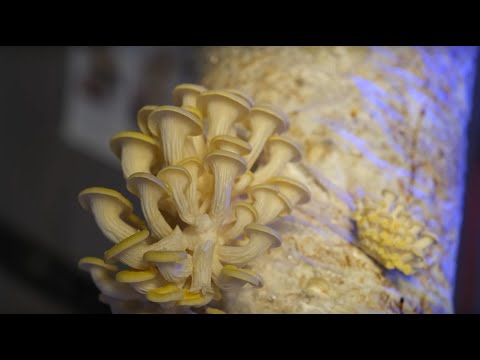
So learn to recognise the mushroom by its form, not by a Latin name on a label. Oyster mushroom has a shell-like or fan-shaped cap, and a stem that is off-centre or effectively absent, with the cap attached at or near its edge. They grow in overlapping clusters. That physical description is what you check when spawn arrives and what you show a buyer.

Now the honest gap. Exact upper and lower lethal temperature limits for the specific Pleurotus strains most commonly grown in African markets were not retrieved. This course therefore gives you no number for how hot is too hot or how cold is too cold for your particular strain. Do not let anyone hand you one without a source.

What you do instead is exactly what a good beekeeper does with their own bees: teach yourself by observation. Use the sourced fruiting range of 20 to 26 degrees as your target. Record your own room temperature alongside your own colonisation times and yields, batch by batch. Within a few cycles you will know how your strain behaves in your room across your seasons, which is a better piece of knowledge than any imported lethal-limit figure would have been.

One practical point about buying. Because the trade names overlap and the taxonomy is contested, do not pay a premium for a species name you cannot verify. Pay attention instead to what Module 4 teaches you to check: whether the spawn in front of you is clean, white, evenly colonised and vigorous. That is the quality that decides your crop.

Oyster spawn-run temperature
25 to 30 degrees Celsius
Botswana production guide. Achievable without heating across much of tropical Africa, which is why oyster mushroom needs shade and ventilation rather than machinery
Oyster fruiting temperature
20 to 26 degrees Celsius
Botswana production guide. Fruiting runs cooler than spawn run, which is the temperature drop that helps trigger pinning
Nigerian single-band result
26 degrees Celsius plus or minus 1 to 2 for both stages, BE up to 48.83 percent
One encouraging African data point suggesting active temperature control may not be needed in a mid-twenties climate. Whether it holds across other African climates was not retrieved
Lethal temperature limits for African Pleurotus strains
not available - observe your own
Not retrieved for the strains commonly grown in African markets. Use the sourced fruiting range as a target and build your own record of how your strain behaves in your room
Do this today: find one oyster mushroom, in a market, a shop or a neighbour's crop, and look at where the stem joins the cap. Off-centre or absent, with a shell-shaped cap, is what you are learning to recognise.

Recommended viewing

These are free videos made by other people, not by rise AFRICA skills. Each one was checked against YouTube and is on topic. The written lessons are the course. Treat these as useful extra watching.

How to Easily Grow Oyster Mushrooms at Home

Von Malegowski

How to Grow Oyster Mushrooms on Straw: Introduction Part 1 of 5

cornellsmallfarms

SUPER LOW TECH OYSTER MUSHROOMS (and market garden update)

Richard Perkins

Lesson 3.3~12 min

Button Mushroom and the Cooling Problem

In this lesson
  • Explain why Agaricus is structurally harder in a lowland tropical climate
  • State that no African Agaricus trial data exists and what that means for you
  • Cost the cooling requirement honestly before committing to the crop

Button mushroom, Agaricus bisporus, is the mushroom your urban customers already recognise. It is also, biologically, the harder crop for lowland tropical Africa, and this lesson explains exactly why so you can make the decision with your eyes open rather than being either sold it or scared off it.

Start with the gap, because it frames everything else. No African compost trial or field yield figure for Agaricus bisporus was retrieved in the evidence base behind this course. None. Every Agaricus compost and cropping number available here comes from temperate research in Pennsylvania in the United States, or from a Turkish trial using tea-waste compost. Neither is African evidence.

This course therefore gives you no African Agaricus yield figure, no African compost recipe and no achievable-without-cooling cropping-room temperature target for a lowland tropical site, because none exists in this evidence base. If you want those figures, you will have to go and find primary research yourself, or generate the data yourself and be the first person to publish it. That is a real opportunity for a determined grower. It is not a reason to start blind.

Now the structural problem. Agaricus is grown on compost, not on the simple pasteurised bulk substrate that oyster mushroom uses, and that compost is deliberately fermented hot. In the Turkish tea-waste trial, the compost peaked at 70 to 86 degrees Celsius during turning. That is a Phase I and Phase II composting process, considerably more involved than the short 3 to 4 day pre-ferment used in the oyster method you will meet in Module 6.

Then comes the twist that catches people out. Having run the compost hot, the crop then needs a cooler environment than oyster mushroom for fruiting. Commercial Agaricus cropping rooms in the temperate literature are run with active refrigeration and ventilation control. So the crop needs heat in the compost yard and cool in the cropping room, and in a lowland tropical climate the cool half is the expensive half.

That is the central engineering problem: achieving and holding a cool enough cropping-room temperature without mechanical cooling. It is unsolved in this course's evidence base. Treat it as an open engineering problem, not a solved one that someone simply forgot to tell you about.

So when does Agaricus make sense? On three conditions, all of which have to be true together.

  1. You have a genuinely cool site - a highland climate, or reliable night-time cooling you have actually measured, not assumed.
  2. Or you have capital for refrigeration or air conditioning, and you are willing to carry that running cost every cycle.
  3. And you have a buyer who specifically wants button mushroom and will pay for it.

If you meet those, Agaricus is a real, teachable crop and worth pursuing. If you do not, you are proposing to solve an unsolved engineering problem with money you may not have, in order to grow a crop nobody has published African data on.

The honest commercial move if you are tempted is to cost the cooling before anything else. Get one real quotation for the cooling equipment your room would need and one honest estimate of its electricity consumption, then put both into the six cost categories from Module 1 and see what happens to your break-even. Do that arithmetic before you buy spawn, not after.

One more thing worth knowing about Agaricus in case you pursue it. Its compost has an optimal carbon to nitrogen ratio of about 17, which is a lower ratio - more nitrogen relative to carbon - than oyster mushroom substrate wants. That is a genuinely different material with a genuinely different preparation process, which is one more reason not to think of Agaricus as simply oyster mushroom with a different spawn.

And be aware that the detailed Agaricus disease literature available - dry bubble and wet bubble, described in United States extension material as by far the most common fungal disease among commercially cultivated white button mushrooms - is also entirely non-African. If you grow Agaricus in Africa, you are working ahead of the published evidence in almost every direction at once.

African Agaricus trial data
none retrieved
No African compost trial or field yield figure exists in this course's evidence base. Every available number is from Pennsylvania or a Turkish tea-waste compost trial
Agaricus compost peak temperature
70 to 86 degrees Celsius during turning
From the Turkish tea-waste compost trial, not African evidence. Compost is fermented hot, but the cropping room must then run cool - the opposite problem
Agaricus compost C:N ratio
about 17
MushWorld handbook. Lower than oyster mushroom substrate wants, meaning a genuinely different material and preparation process, not oyster growing with different spawn
Cooling target for a lowland tropical Agaricus room
not available - unsolved in this evidence base
No sourced achievable-without-mechanical-cooling temperature target exists. Treat it as an open engineering problem and cost the cooling equipment before buying spawn
Do this today: measure the coldest temperature your intended growing space reaches overnight, and write it down. If you are considering button mushroom, that single number is the start of your feasibility case.

Recommended viewing

These are free videos made by other people, not by rise AFRICA skills. Each one was checked against YouTube and is on topic. The written lessons are the course. Treat these as useful extra watching.

Economics Of Mushroom Production | GroCycle

GroCycle

How to Easily Grow Oyster Mushrooms at Home

Von Malegowski

How to Grow Oyster Mushrooms on Straw: Introduction Part 1 of 5

cornellsmallfarms

Lesson 3.4~11 min

The Other Species Named in the African Literature

In this lesson
  • Name the species commonly cultivated across tropical Africa and their evidence gaps
  • Explain why Termitomyces cannot be cultivated
  • Decide when a named species is safe to attempt commercially

Beyond oyster and button mushroom there are several species you will hear named. Each has a different evidence position, and knowing which is which stops you from betting a season on a name somebody mentioned confidently.

Pleurotus tuber-regium, sometimes called king tuber oyster, is repeatedly named in the tropical Africa cultivation review as one of the most commonly cultivated species alongside P. ostreatus and Lentinus squarrosulus. It is unusual among cultivated oyster mushrooms because it forms an underground sclerotium - a hard storage tuber - which is itself eaten and traded in parts of West Africa, in addition to the mushroom cap. That means potentially two saleable products from one crop.

But here is the position honestly: specific African biological efficiency or yield figures for P. tuber-regium were not retrieved beyond it being named as commonly grown. So this course gives you no yield number for it. If you want to grow it as a named commercial crop, find a dedicated trial and read it before quoting anyone a figure, including yourself in your own business plan.

Lentinus squarrosulus is named alongside those two as one of the most commonly cultivated fungi across the 93 papers surveyed in that tropical Africa review. That tells you real African growers really cultivate it. But no substrate, temperature or yield figure specific to it was retrieved. Same position: real crop, no numbers here.

Volvariella volvacea, the paddy straw mushroom, is a genuinely tropical, fast-cycling species grown widely in South-east Asia on rice straw, and its temperature and pH tolerances have been studied. It sounds ideal for tropical Africa, and it may well be. But no African cultivation trial, substrate figure or yield figure for it was retrieved. It should not be taught as a proven African crop on the strength of this course's evidence. It is named here so you know it exists and so you know exactly what the evidence gap around it is.

There is also a specific safety point attached to Volvariella that you will meet in Lesson 5, and you should read that lesson before handling it.

Termitomyces is different in kind, not just in evidence. These are the termite mushrooms prized across much of Africa, and they appear in the Nigeria and Kenya consumer-preference review as a species people genuinely value - Termitomyces striatus is measured at 7.5 mg of iron and 2.1 mg of zinc per 100 g. There is a real market and people will pay well for them in season.

But they are wild-harvested from termite mounds, not cultivated. They live in an obligate symbiosis with a fungus-farming termite colony, and that relationship has never been reliably reproduced in artificial cultivation. So there is no cultivation method to teach you. Anyone who tells you they can teach you to farm Termitomyces is selling you something that does not exist.

What Termitomyces can be, for a grower, is a seasonal traded product alongside a cultivated crop - and only if you already have reliable, experienced local identification knowledge of that specific, well-known species and its distinctive termite-mound habitat. That is a narrow exception, not an invitation to forage generally, and Lesson 5 explains why the distinction matters so much.

So here is the rule for deciding whether a named species is safe to attempt commercially. Ask three questions. Has anybody published a cultivation method for it? Has anybody published a yield or biological efficiency figure measured in conditions like mine? And can I identify it reliably myself? Oyster mushroom answers yes to all three. Agaricus answers yes to the first, no to the second in Africa. Tuber-regium and Lentinus squarrosulus answer yes to the first, no to the second here. Termitomyces answers no to the first outright.

That is not a reason to never try anything new. It is a reason to try new species as a small, recorded trial alongside a crop that pays your bills, rather than as the crop that has to pay your bills.

Papers surveyed in the tropical Africa review
93
P. ostreatus, P. tuber-regium and Lentinus squarrosulus were the most commonly cultivated species named across them - real evidence of what African growers actually grow
African yield data for P. tuber-regium
not available
Named as commonly cultivated, but no African biological efficiency or yield figure was retrieved. Find a dedicated trial before putting a number in any plan
Termitomyces striatus iron and zinc
7.5 mg iron and 2.1 mg zinc per 100 g
A real nutritional and market value. But the species is wild-harvested only - the termite symbiosis has never been reliably reproduced in cultivation
African cultivation data for Volvariella volvacea
none retrieved
A genuinely tropical, fast-cycling species widely grown in South-east Asia, but no African trial, substrate or yield figure was retrieved. Also carries a specific safety warning in Lesson 5
Do this today: ask two older people in your area which mushrooms they know and eat locally, and write down the names they use. Local knowledge tells you what your market already recognises, which is different from what you can cultivate.

Recommended viewing

These are free videos made by other people, not by rise AFRICA skills. Each one was checked against YouTube and is on topic. The written lessons are the course. Treat these as useful extra watching.

SUPER LOW TECH OYSTER MUSHROOMS (and market garden update)

Richard Perkins

How to Grow Oyster Mushrooms on Straw: Introduction Part 1 of 5

cornellsmallfarms

How to Easily Grow Oyster Mushrooms at Home

Von Malegowski

Lesson 3.5~12 min

Wild Mushrooms: The Life-Safety Lesson

In this lesson
  • State why folk tests for wild mushroom safety are not valid
  • Describe the delayed clinical course of amatoxin poisoning
  • Apply the single rule that governs all wild-collected mushrooms

This lesson is not farming advice. It is a safety warning, and it should be read with the same seriousness as a medical instruction. Read all of it before you handle, sell or advise anybody about any wild-collected mushroom.

Amatoxins are the toxin group responsible for the overwhelming majority of fatal mushroom poisonings worldwide. Approximately 95 percent of mushroom-poisoning deaths worldwide are attributed to amatoxin-containing species. Those species are found in the genera Amanita - including A. phalloides, A. virosa, A. verna, A. ocreata, A. bisporigera and A. suballiacea - as well as Lepiota, Galerina and Conocybe.

Now the fact that makes this dangerous rather than merely serious. Amatoxin-containing mushrooms are large, 5 to 15 cm, have no distinctive taste or smell, and are frequently visually indistinguishable in colour or general appearance from edible species. The deadliest mushrooms do not look, smell or taste dangerous.

That single sentence destroys every folk method you may have been taught. Testing a wild mushroom by smell does not work. Tasting a small piece does not work. Colour-change reactions with silver or with onion do not work. Whether animals eat it does not work. None of these methods are validated in the sourced clinical literature, and this course teaches none of them as safe. If someone shows you one of these tests confidently, they have simply not yet been unlucky.

Next, the clinical course, which is a trap rather than a warning. After eating an amatoxin-containing mushroom there are typically no symptoms at all for at least 6 hours. Gastrointestinal symptoms - nausea, cramping, diarrhoea - then follow. And those are frequently followed by an apparent recovery lasting 2 to 3 days, during which the person often feels better while liver damage is actually progressing. Then liver and kidney failure can develop within 3 to 7 days of eating it.

Read that sequence again and see what it does to a family. The person feels fine all evening. They are ill the next day. Then they seem to get better, so nobody goes to hospital. By the time the real damage becomes obvious, it has been progressing for days.

So the practical rule is this. Anyone who has eaten an unidentified wild mushroom and later develops any gastrointestinal symptoms, however mild, and however much time has passed, needs medical attention immediately - not once the symptoms seem serious. Do not wait for the apparent recovery to pass. That is exactly the trap.

Now the point that connects this to Lesson 4. Amanita phalloides specifically is documented in the clinical literature as commonly mistaken for the paddy straw mushroom, Volvariella volvacea. That is a direct, sourced example of the exact confusion this lesson exists to prevent - a real, edible, tropical species that a genuinely deadly look-alike can be confused with by an untrained forager.

Here is what this course does about all of it.

This course teaches cultivation of named, spawn-propagated species only. It does not teach, endorse or provide any identification guide for foraging unknown wild mushrooms for sale or for eating. What you grow from spawn you know, because you put it there.

Where Termitomyces is discussed as a wild-harvested market product, it should only be harvested by someone who already has reliable, experienced local identification knowledge of that specific, well-known species and its distinctive termite-mound habitat. That is a narrow exception for one recognisable species with a distinctive habitat. It is never an invitation to forage unfamiliar mushrooms generally on the strength of one example.

Be aware of one more gap. No African country-specific mushroom-poisoning incidence, hospital-admission or fatality data was retrieved, so this course gives you no African poisoning statistic. That absence does not weaken the warning at all. The biochemistry of amatoxin poisoning is not African, Asian or European - it is the same everywhere the relevant genera grow, and Amanita, Lepiota, Galerina and Conocybe all have described African species.

The rule, finally, and it is one rule rather than a list of safe features: never eat, sell, or advise a customer to eat any wild-collected mushroom that has not been positively identified by someone with genuine, verified expertise in the mushrooms of that specific region. A list of safe-looking features is not a safe identification method, because the deadliest species do not present as dangerous.

Share of fatal mushroom poisonings from amatoxins
approximately 95 percent worldwide
Found in Amanita, Lepiota, Galerina and Conocybe species, all of which have described African species
Delay before any symptoms
typically none for at least 6 hours
Followed by gastrointestinal symptoms. The absence of early symptoms is why people believe a mushroom was safe when it was not
Apparent recovery period
2 to 3 days
The person often feels better while liver damage is progressing. This false recovery is the reason families delay seeking help until the poisoning is severe
Time to organ failure
liver and kidney failure within 3 to 7 days of eating
Anyone who has eaten an unidentified wild mushroom and develops any gastrointestinal symptoms needs medical attention immediately, whatever the delay so far
Do this today: tell one other person in your household the 6-hour delay and the 2 to 3 day false recovery. If anyone in your home ever eats a wild mushroom and feels ill, that knowledge is what gets them to a hospital in time.

Recommended viewing

These are free videos made by other people, not by rise AFRICA skills. Each one was checked against YouTube and is on topic. The written lessons are the course. Treat these as useful extra watching.

How to Easily Grow Oyster Mushrooms at Home

Von Malegowski

How to Grow Oyster Mushrooms on Straw: Introduction Part 1 of 5

cornellsmallfarms

Growing Oyster Mushrooms Indoors - SPAWN & SAWDUST BLOCK PRODUCTION (2 of 5)

cornellsmallfarms

Lesson 3.6~11 min

Matching the Species to Your Site and Your Buyer

In this lesson
  • Combine site temperature, substrate availability and buyer demand into one decision
  • State the nutritional claims you can make honestly to a buyer
  • Write a dated species decision you can review after a season

This lesson brings the module together into one decision you actually write down.

You now have four inputs. Your site's real measured temperatures. What waste materials are cheap or free near you. What your buyers say they want. And the evidence position for each candidate species.

Work them in that order, because it moves from what you cannot change to what you can.

Site first. If your measured room sits mostly in the twenties, oyster mushroom's sourced targets of 25 to 30 degrees for spawn running and 20 to 26 for fruiting are within reach without machinery. Remember the Nigerian trial ran both stages at 26 degrees plus or minus 1 to 2 and still reached 48.83 percent biological efficiency on its best combination. If your room regularly runs hotter than the fruiting band, your first investment is shade and ventilation, not a different species.

Substrate second. This is covered in detail in Module 5, but for the species decision it matters because oyster mushroom eats the widest range of what is likely to be free near you. Cotton is regionally limited to cotton-growing zones, while maize cobs, banana waste and local sawdusts are far more universally available across African smallholder systems.

Buyer third. If your buyer specifically wants button mushroom and will pay for it, and your site is cool or you can afford cooling, that is the one combination where Agaricus makes sense. If your buyer simply wants mushrooms, oyster mushroom serves them and costs you far less to hold conditions for.

Evidence last, as the check on the other three. Would I be growing something with published results in conditions like mine, or would I be first?

Now the marketing side, because your species choice affects what you can honestly say. Mushrooms have a genuine nutritional story and it is worth using - but attribute the numbers to the species they were measured on rather than generalising across mushrooms as a category. Pleurotus ostreatus is measured at 30 to 35 percent protein on a dry-weight basis, with selenium up to 25.8 micrograms per 100 g and beta-glucans up to 7.8 percent of dry weight. Lentinula edodes, shiitake, is 32 percent protein on the same basis - included here only for comparison, since it is not established as an African-cultivated crop in this course's evidence base.

And repeat the discipline from Module 2, because it is where honest growers get caught out. Those are dry-weight figures. Fresh mushroom is 85 to 95 percent water, so a 100 g fresh serving does not contain 30 to 35 g of protein. Never quote a dry-weight percentage to a customer as if it were a fresh-weight figure. What you can say, defensibly, is that mushrooms are a notable source of plant-based protein and micronutrients relative to their cost and growing footprint.

Remember too what Module 1's consumer evidence said about what actually sells: taste is rated the most important purchase factor by roughly 50 percent of African consumers surveyed, with texture lowest at about 15 percent. So lead with flavour and freshness. The nutrition is a supporting argument for the buyer who asks, not your opening line.

Finally, write the decision down and date it. One page. Name the species. Give the three pieces of evidence that decided it - your own temperature record, your buyer conversations, your substrate list. And name the one condition that would make you change your mind: a buyer contract that pays for cooling, a highland site becoming available, a substrate becoming free.

That last part matters more than it sounds. In a year, when a batch has failed or a neighbour is boasting about a different crop, you will want to know what you actually believed at the start and why. A dated decision written by you, based on measurements you took, is the difference between adjusting a plan and abandoning one.

Pleurotus ostreatus protein
30 to 35 percent, dry-weight basis
Never quote as a fresh-weight figure - fresh mushroom is 85 to 95 percent water. Attribute nutrient figures to the species measured, not to mushrooms as a category
Shiitake protein, for comparison
32 percent, dry-weight basis
Lentinula edodes is included for comparison only; it is not established as an African-cultivated crop in this course's evidence base
Taste as a purchase factor
about 50 percent of African consumers surveyed
Texture ranked lowest at about 15 percent. Lead your selling with flavour and freshness; nutrition is the supporting argument for the buyer who asks
Cotton waste availability
regionally limited to cotton-growing zones
Maize cobs, banana waste and local sawdusts are far more universally available across African smallholder systems, which matters for a species that must eat what is near you
Do this today: write four lines on one page - my measured room temperature range, my cheapest substrate, what my buyers said, and the species I choose. Sign it and date it.

Recommended viewing

These are free videos made by other people, not by rise AFRICA skills. Each one was checked against YouTube and is on topic. The written lessons are the course. Treat these as useful extra watching.

SUPER LOW TECH OYSTER MUSHROOMS (and market garden update)

Richard Perkins

Economics Of Mushroom Production | GroCycle

GroCycle

How to Easily Grow Oyster Mushrooms at Home

Von Malegowski

Knowledge check

Questions from all lessons. Click an answer to see whether it is right and why.

1. Which two criteria should decide your species choice?

Climate fit decides whether you must buy machinery to hold conditions; evidence decides whether anyone has actually shown the crop works in conditions like yours.

2. How much African compost or yield trial data exists for Agaricus bisporus in this course's evidence base?

No African compost trial or field yield figure for Agaricus was retrieved. Every available number is from temperate research or a Turkish tea-waste compost trial, and that gap should be stated to any learner considering the crop.

3. Your site is lowland, you have no cooling, and maize cobs are free nearby. What does the decision aid point to?

Both conditions - no cooling at a lowland site, and cheap local lignocellulosic waste - point the same way. Oyster mushroom fruits at 20 to 26 degrees Celsius, achievable without refrigeration in much of tropical Africa.

4. Why is button mushroom commercially tempting despite the evidence gap?

Recognition means less customer education, which matters given that only 38 percent of respondents in the Nigerian survey ate mushrooms regularly. But recognition does not solve the cooling problem.

5. What is the correct order of reasoning when choosing a species?

Starting from buyer preference and working backwards leads growers to spend capital on cooling, or to start a crop whose conditions they cannot hold and lose the batch.

6. What is the sourced fruiting-phase temperature target for oyster mushroom?

The Botswana guide gives 20 to 26 degrees for fruiting against 25 to 30 for spawn running. Both are reachable without refrigeration in much of tropical Africa, which is the crop's central commercial advantage.

7. How should you identify oyster mushroom?

Trade names overlap and species boundaries are actively debated by taxonomists. The physical form is what you can verify yourself when spawn arrives or when you show a buyer.

8. In the Nigerian trial, how did the three Pleurotus species compare on the same substrate?

Differences between substrates were far larger than differences between these species. That is why substrate choice, not species-level taxonomy within the oyster group, is where your attention belongs.

9. What does this course give you as the lethal temperature limit for your Pleurotus strain?

Nobody should hand you an unsourced lethal limit. Use the sourced 20 to 26 degree fruiting range as a target and record how your own strain behaves in your own room across seasons.

10. Why should you not pay a premium for a specific oyster species name?

Pleurotus florida is a trade name rather than a formally accepted species in all classifications, and the Nigerian trial found broadly similar performance across the three species tested.

11. How many African Agaricus compost or yield trials are in this course's evidence base?

Every Agaricus number available comes from Pennsylvania or a Turkish tea-waste compost trial. A grower attempting Agaricus in Africa is working ahead of the published evidence.

12. What is the central engineering problem for Agaricus in lowland tropical Africa?

The compost is fermented hot on purpose, but fruiting needs a cooler room than oyster mushroom fruiting. In a hot climate the cool half is the expensive half, and no sourced African solution exists.

13. What temperature did the Turkish trial's compost peak at during turning?

That is a full Phase I and Phase II composting process, far more involved than the short 3 to 4 day pre-ferment used in the oyster method. And it is Turkish evidence, not African.

14. Which combination makes Agaricus a reasonable choice?

All the conditions have to be true together. Without them you are solving an unsolved engineering problem with money you may not have, for a crop with no African published data.

15. What should you do first if you are tempted by Agaricus?

The cooling cost is the decisive variable and it is knowable before you spend anything on the crop. Doing that arithmetic after buying spawn is how growers discover they cannot afford the cycle.

16. Why can Termitomyces not be cultivated?

There is no cultivation method to teach. It can be a seasonal traded product for someone with genuine local identification knowledge, but anyone offering to teach you to farm it is selling something that does not exist.

17. What is unusual about Pleurotus tuber-regium?

That potentially gives two saleable products from one crop. But no African biological efficiency or yield figure for it was retrieved, so this course gives you no number to plan on.

18. What is the evidence position on Volvariella volvacea in Africa?

It is widely grown in South-east Asia and its temperature and pH tolerances have been studied, but nothing African was retrieved. It also carries a specific misidentification warning covered in the next lesson.

19. What are the three questions to ask before attempting a named species commercially?

Oyster mushroom answers yes to all three. Termitomyces fails the first outright. Knowing which question a species fails tells you exactly what risk you would be taking.

20. How should a new species be attempted?

Trying something new is reasonable. Betting the season on a species with no published yield figure for your conditions is not, and a recorded trial gives you the data nobody else has published.

21. Why do folk tests such as smell, taste or colour change with silver not work?

The deadliest mushrooms do not look, smell or taste dangerous. None of these methods are validated in the clinical literature, and confidence in them is exactly what kills people.

22. How long after eating an amatoxin-containing mushroom do symptoms typically begin?

The delay is why a person believes the mushroom was safe. Gastrointestinal symptoms follow, then an apparent recovery of 2 to 3 days, then liver and kidney failure within 3 to 7 days.

23. Which edible tropical species is Amanita phalloides documented as commonly mistaken for?

It is a sourced, specific example of a real edible tropical species with a deadly look-alike, which is why this course teaches cultivation of spawn-propagated species rather than foraging.

24. Someone ate an unidentified wild mushroom yesterday, was sick, and today feels much better. What should happen?

The 2 to 3 day apparent recovery happens while liver damage progresses. Waiting for symptoms to become obviously serious is precisely what makes amatoxin poisoning fatal.

25. What is the single rule governing wild-collected mushrooms?

A list of safe-looking features is not a safe method, because the deadliest species do not present as dangerous. Amatoxin-containing species are 5 to 15 cm and unremarkable in appearance.

26. In what order should the four inputs be worked?

It moves from what you cannot change to what you can. Your site's real temperature is fixed without capital; your buyer relationships and substrate sourcing can be worked on.

27. Your room regularly runs hotter than the oyster fruiting band. What is the first investment?

The Nigerian trial reached 48.83 percent BE running both stages at about 26 degrees. Shade and ventilation are far cheaper than machinery and usually enough in a mid-twenties climate.

28. A customer asks whether your mushrooms are nutritious. What can you say honestly?

The 30 to 35 percent protein figure is on a dry-weight basis and fresh mushroom is 85 to 95 percent water. The defensible claim does not need an inflated number to be persuasive.

29. Why is cotton waste a weaker planning assumption than maize cobs across Africa?

Cotton performed very well in both the Ethiopian and Nigerian trials, so the issue is availability, not performance. Maize cobs, banana waste and local sawdusts are far more universally available.

30. Why should the species decision be written down and dated?

A dated decision based on measurements you took yourself is the difference between adjusting a plan on evidence and abandoning one on someone else's confidence.

Module 3 capstone

Make a documented species decision for your own site rather than copying someone else's. Step 1: record your site's altitude and, over two full weeks, the temperature inside your intended growing space at dawn, at midday and at night, written down every single day. Step 2: compare your recorded range against the sourced spawn-run target of 25 to 30 degrees Celsius and fruiting target of 20 to 26 degrees Celsius for oyster mushroom, and write down how many hours a day your space sits inside each band without any equipment. Step 3: price mechanical cooling locally - one quotation, with the supplier's name and date - so you know what it would cost to hold a cooler room if you were tempted by button mushroom. Step 4: ask three buyers from Module 1 which mushroom they actually want and whether they would buy oyster mushroom if you supplied it consistently. Step 5: list every one of the substrates in Module 5 that is genuinely cheap or free within reach of you. Step 6: write a one-page species decision naming the species you will grow, the three pieces of evidence that decided it - your own temperature record, your buyer answers and your substrate availability - and the one condition that would make you change your mind. Date it and keep it, because in a year you will want to know what you actually believed and why.

Price check, always. Before you buy ingredients, equipment, or commit to a supplier, call three suppliers and compare prices. Prices and ingredient availability vary widely by region and season. This course teaches the method. You confirm the local numbers with your own research and with your veterinarian or animal nutritionist.